
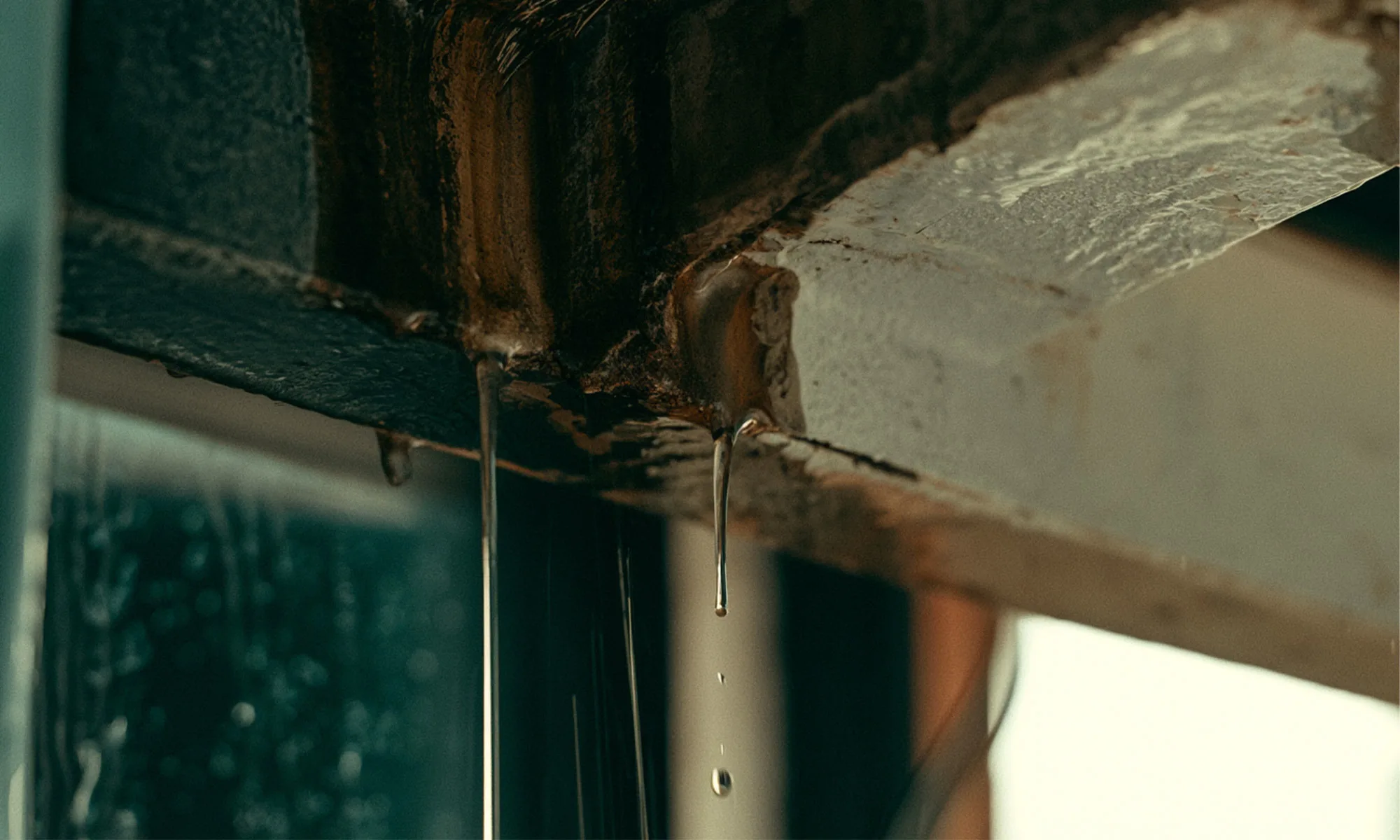
One of the most common questions we hear every monsoon season is some version of: "My ceiling is fine most of the year, but the moment it rains heavily, a patch appears. What's going on?"
The pattern itself is the clue. Plumbing leaks — from a burst pipe, a failed joint, or a leaking tank — are usually continuous. They don't care whether it's raining outside. If a leak only appears during or shortly after rainfall, the water is almost always entering through the building's exterior envelope: the terrace, an external wall, or a balcony.
How water actually travels once it gets in
One thing that confuses a lot of homeowners is that the damp patch on the ceiling often isn't directly below the actual entry point. Water doesn't fall straight down through a slab the way it would in open air. Once it gets past a compromised membrane, it spreads along the underside of the slab, following the path of least resistance — often tracking along embedded reinforcement bars, construction joints, or slight variations in slab thickness — before finding a low point to drip through.
This is why patching the visible stain rarely works. The stain is where the water chose to exit, not necessarily where it chose to enter. A proper diagnosis has to work backwards from the visible symptom to the actual point of ingress, which is often some distance away — sometimes on the opposite side of the room, or even in an adjacent one.
What's usually happening at the source
Terraces and roofs take the brunt of monsoon exposure. Over time, waterproofing membranes age, crack, or lose adhesion at the edges. Once that barrier is compromised, rainwater finds a path through the slab and shows up as a stain on the ceiling below — sometimes directly under the failure point, sometimes several feet away, depending on how the water travels along the slab or rebar.
Exterior walls behave similarly. Hairline cracks that are invisible in dry weather open up just enough during wind-driven rain to let moisture in, especially around window frames and construction joints. In multi-storey buildings, a leak on a lower floor can sometimes originate from a failure several floors up, with water traveling down through a shared wall cavity or duct before it becomes visible.
A few specific weak points come up again and again in Delhi NCR construction: parapet-to-slab junctions on terraces, where two different pours meet and are prone to cracking; expansion joints that were never properly sealed during original construction; and penetrations for AC units, pipes, or antennas installed after the original waterproofing was done, which frequently break the membrane's continuity without anyone resealing around them.
Why 'wait and watch' doesn't work
Because the leak disappears once the rain stops, it's tempting to ignore it until next monsoon. But the moisture that got in during each rain event doesn't fully dry out between spells, especially in humid weather. Each subsequent rain adds to it, which is why the same patch often gets larger — or new patches appear — as the season goes on.
Over multiple monsoons, this pattern compounds. What starts as a faint discoloration can progress to visible bubbling or flaking paint, then to a genuinely wet patch that stays damp even between rain events, and eventually to signs of efflorescence — the white, powdery salt deposits left behind as water evaporates and carries dissolved minerals out of the concrete. By the time efflorescence shows up, the water has typically been finding its way in for more than one season.
There's also a structural angle worth understanding: the same reinforcement bars that give concrete its tensile strength are vulnerable to corrosion when repeatedly exposed to moisture. Corroding steel expands, which puts pressure on the surrounding concrete and can eventually cause it to crack or spall. This is a slow process — it isn't something that happens after a single monsoon — but it's also not something that reverses on its own once it starts.
What to check before you call someone
If you're dealing with a seasonal leak, a few observations will make any diagnosis faster and more accurate. Note whether the patch appears only during heavy rain or also after lighter showers, since that can indicate how compromised the membrane is. Check whether the location of the patch has changed or grown over successive rain events. If you can safely access the terrace or exterior wall above the affected area, look for visible cracks, areas where the surface coating looks worn or patchy, or standing water that isn't draining properly.
Photographs taken during or shortly after a rain event are particularly useful, since some symptoms — like a faint damp patch — are much harder to see once everything has dried out.
The practical takeaway
A leak that's seasonal isn't a smaller problem than a constant one. It just means the entry point is on the exterior rather than in the plumbing, which changes where you should be looking and what kind of system is likely to fix it. Either way, the goal is the same: trace the water back to where it's actually entering, not just where it's showing up, and treat that specific point with a system suited to the surface and exposure involved.